

History of the manor
The Manor of SAMES has been created around 1190 by subinfeudation. The manor was held by knight service from the overlord de Lisle, himself vassal of the Bishop of Ely. End of 16th century, SAMES was purchased by same Lord as Crowlands and Lisle both also in Cottenham. But the three manors were not merged, and kept their own separate records. In 2024 a separate sale was done and the present lord owns only SAMES title.
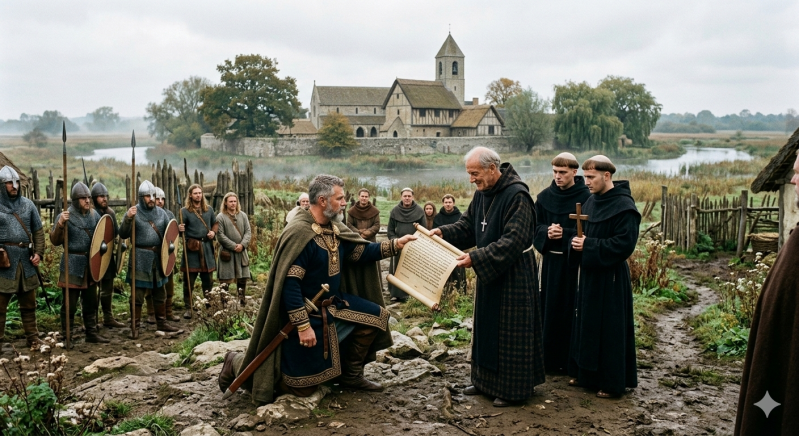
Ely abbey receiving land donation
The Age of Abbeys and the Saxon Land Division (c. 971 – 1066)
In the 10th century, Cottenham was not yet unified but divided between two spiritual giants: the abbeys of Crowland and Ely. This chapter traces the piety of the Saxon nobility, from Athelstan Mannesson to Leofwine, whose successive donations patiently built the "parent" estate of Sames. By 1066, the Abbey of Ely held a major manor of 10 hides, supplemented by the lands of free peasants (sokemen). It is within this original block of land, sanctified by the Church and later recorded in the Domesday Book, that the cradle of our lordship lies. Sames is not an ex-nihilo creation, but the heir to a thousand-year-old land puzzle where soil was already synonymous with devotion and sovereignty.
The Norman Clash and the Rebellion of Ely (1066 – 1109)
Following the Battle of Hastings, Cottenham became a frontline zone. The village stood as a witness to the siege of the Isle of Ely, the final Saxon stronghold led by the legendary Hereward the Wake. Once the rebellion was crushed in 1071, King William enforced a strict "Normanization": the Abbey of Ely was placed under the control of Simeon, a kinsman of the Conqueror. A structural turning point occurred in 1109 when the abbey was elevated to Cathedral status, and Hervey le Breton became the first Bishop of Ely. To meet his military obligations to the Crown, the Bishop began to divide his estates to raise knights. Within this context of iron and faith, the Lordship of Sames began to individualize, emerging from episcopal lands as a strategic pawn on the feudal chessboard.
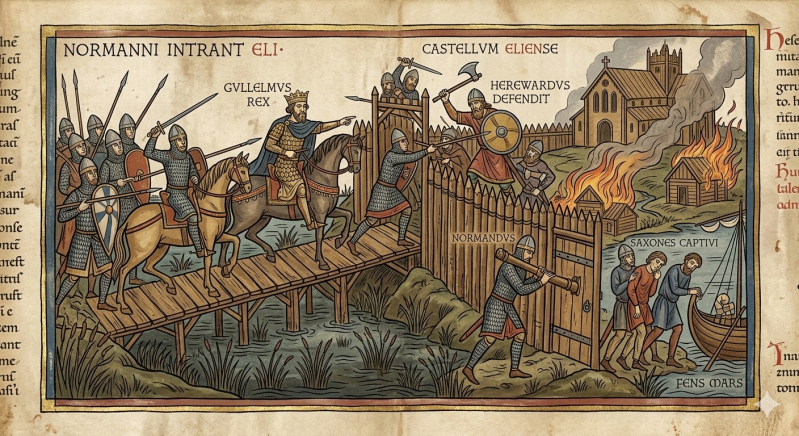
Hereward and William
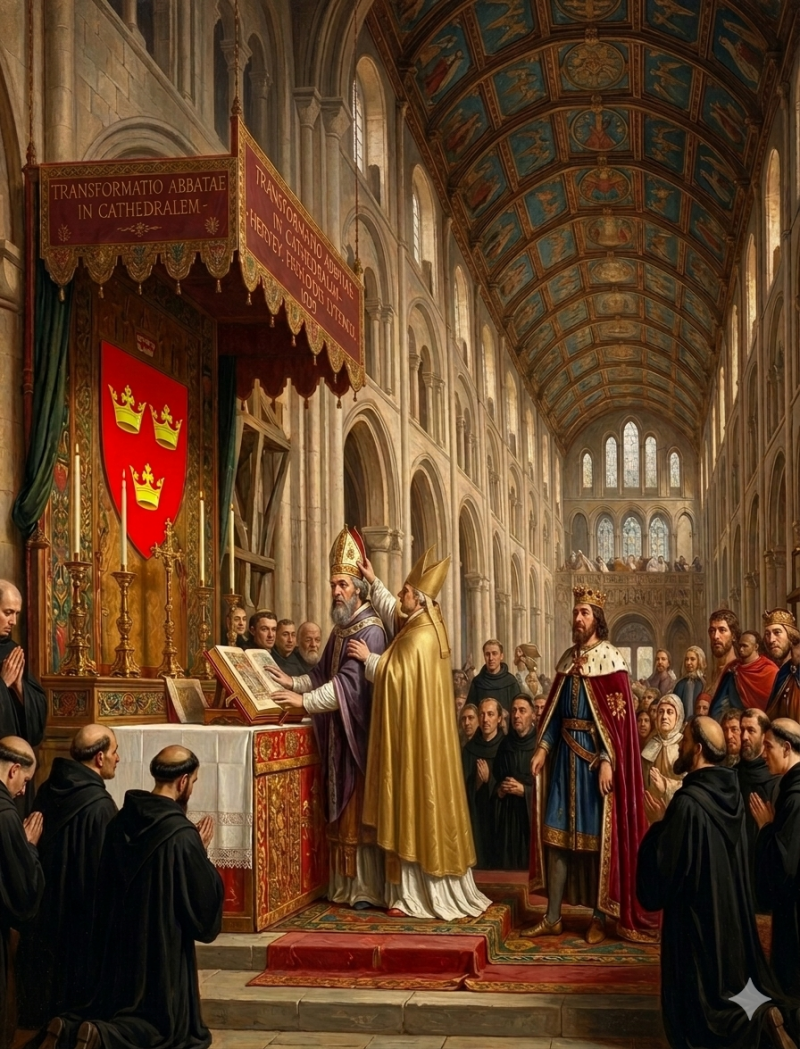
Hervey le Breton, Abbott to Bishop of Ely
The Waleys Dynasty and the Golden Age of the Fief (1166 – 1286)
In 1166, the estate belonged to the powerful De Lisle family, pillars of the diocese holding three knight’s fees. The major turning point occurred in 1190: the "10th hide" was extracted from the main estate to be enfeoffed to Hugh le Waleys. By securing his tenure through the feudal standards of 1190, this Welsh Marches veteran transformed Sames into a knight's fee, anchoring the estate within the Exchequer’s noble hierarchy. For a century, the Waleys reigned as resident lords, defending the boundaries of the estate during the famous Perambulation of 1235. However, in 1286, the lineage ended. During a trial at the Cambridge Assizes, Simon le Waleys had to 'clear' the title before the sale could proceed: he paid 100 shillings to Walter, the occupant, to extinguish his claims. In a striking historical echo, this sum—the standard value of a full knight’s fee a century earlier—served here to liberate the estate. Only then was the domain ceded to Judge William de Saham, and the fief took the name of its prestigious purchaser: Sames.
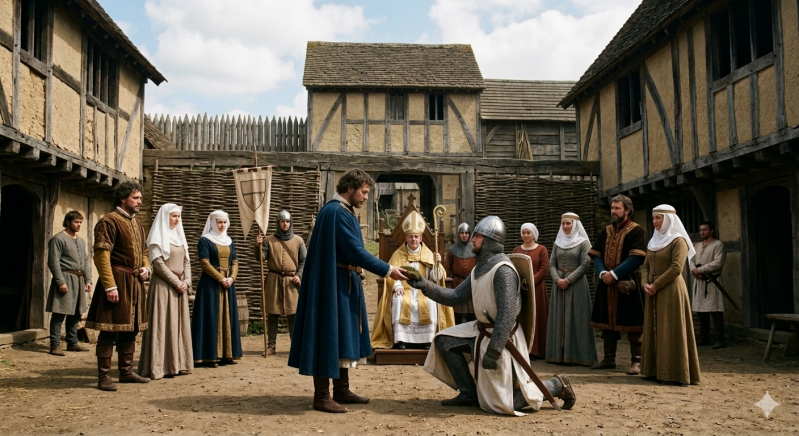
Hugh Le Waleys receives fief in Cottenham
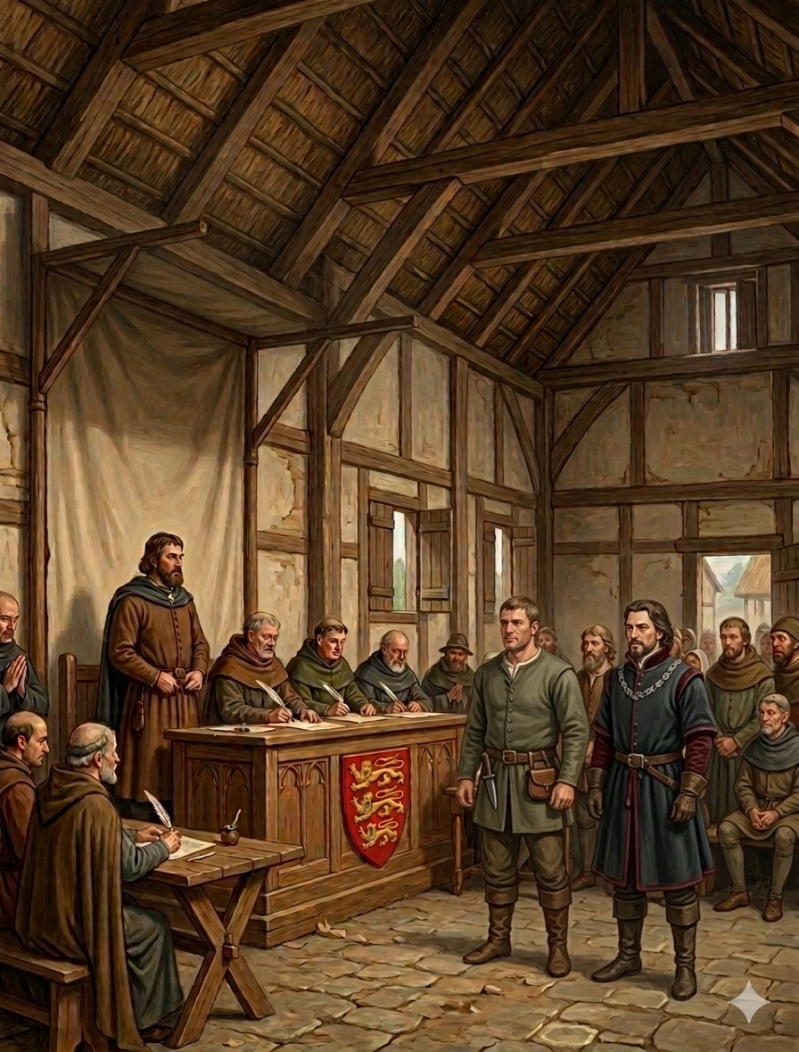
1286 trial - Simon Waleys against Walter
The Saham Cabal and the Twilight of the Waleys (1286 – 1291)
In 1286, the warrior lineage of the Waleys fell before the relentless power of Law and corruption. During a session of the Cambridge Assizes, Simon le Waleys was pressured by Judge William de Saham into a ruinous financial agreement: a debt of 100 shillings that sealed his fate. Exploiting Simon's growing mental instability — his "frenzy" — Judge Saham orchestrated the plundering of his estates, ignoring King Edward I's guardianship orders. Despite a heroic lawsuit filed by Robert de Stanton (Simon's son) in 1289 to expose these malpractices, reasons of state prevailed. Although Judge Saham was eventually convicted for his misconduct, the lands in Cottenham were never returned. The Waleys-Stanton lineage vanished, and the manor was permanently renamed after its judicial predator: the Manor of Sames
The Saham Era and the Windsor Transition (1295 – 1392)
After 1286, the management of Judge William de Saham and his heirs so deeply imprinted their name upon the land that the fief lost its former identity to become the Manor of Sames. In 1389, a formal deed marked the estate's entry into the highest royal circles: it was ceded to John de Windsor, King’s Esquire to Richard II. This rise triggered a violent conflict with Robert de Lisle, the historical overlord, who attempted to evict Windsor by force in 1390. Royal arbitration followed swiftly: from Kennington Palace, Richard II ruled in favor of his esquire, condemning De Lisle's actions. By 1392, a royal inquiry confirmed that the Manor of Sames was held by the prestigious Knight Service, permanently securing its rank and name within the English aristocracy.
From the King's Esquire to the Cambridge Merchant (1389 – 1625)
Following the royal arbitration of 1390, Sames passed through the 15th century under the guidance of legal experts like Thomas Burgoyne. Upon the death of his son John in 1505, the manor underwent a rare transformation: for lack of a male heir, it was split into two halves between his daughters, Elizabeth and Margaret. For nearly a century, the title traveled through various marriage alliances (Heveningham, Thursby, Pepys) before being patiently reunited at the end of the 16th century by Sir Francis Hinde. This powerful Lord of Madingley reintegrated Sames into a single land block alongside the manors of Crowlands and Lisles. However, the Hindes' financial ruin in 1625 signaled the end of the chivalric era: the estate was sold to the famous Thomas Hobson, the Cambridge carrier, marking the rise of the triumphant bourgeoisie.
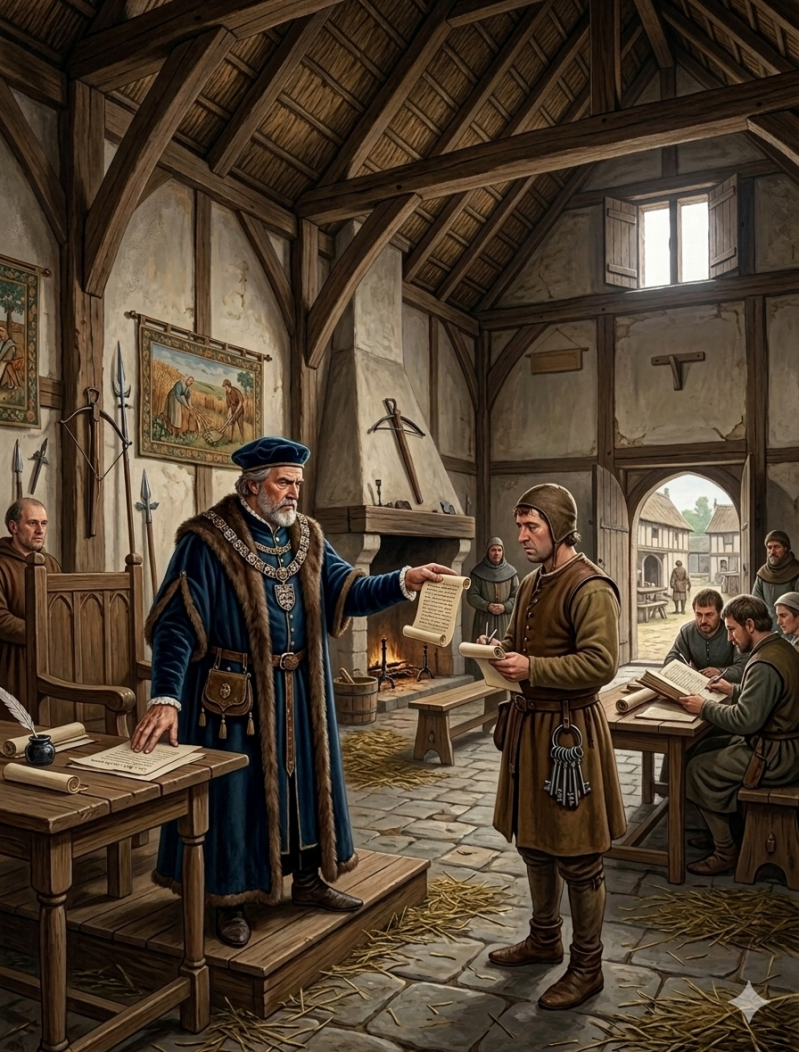
Saham manages his manors
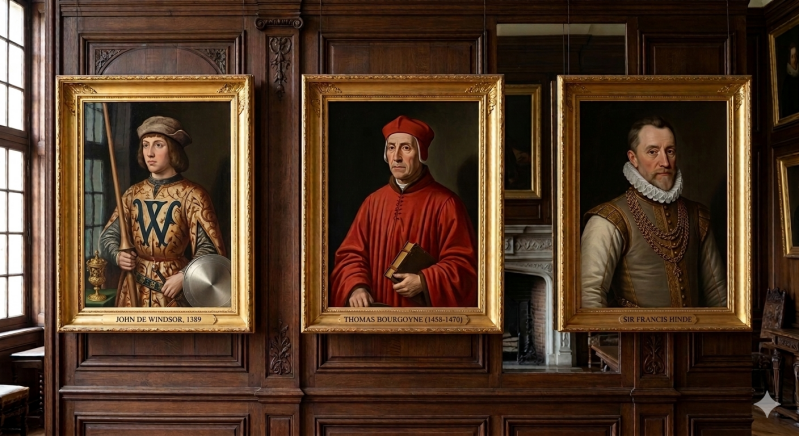
Windsor/Burgoyne/Hinde
From the Hobson Empire to the Finch Unification (1625 – 1826)
In 1625, the famous Cambridge carrier Thomas Hobson acquired Sames, marking the manor’s entry into the era of the merchant bourgeoisie. Following a long period of female regency held by the Hobson and Winde Ladies, the estate passed to scholars and antiquarians such as Roger Gale. However, the 18th century brought a period of peril: upon the death of Ann Snagge in 1770, the manorial rights were fragmented among several heirs. It was the intervention of William Finch Finch that saved the title’s unity. While the physical lands were parcelled out and sold, Finch had the foresight to retain the Manorial Rights (fishing, grazing, jurisdiction). Thanks to this vision, the title of Sames survived land fragmentation, remaining an intact legal entity until its final transfer in the 19th century.

Hobson to Finch
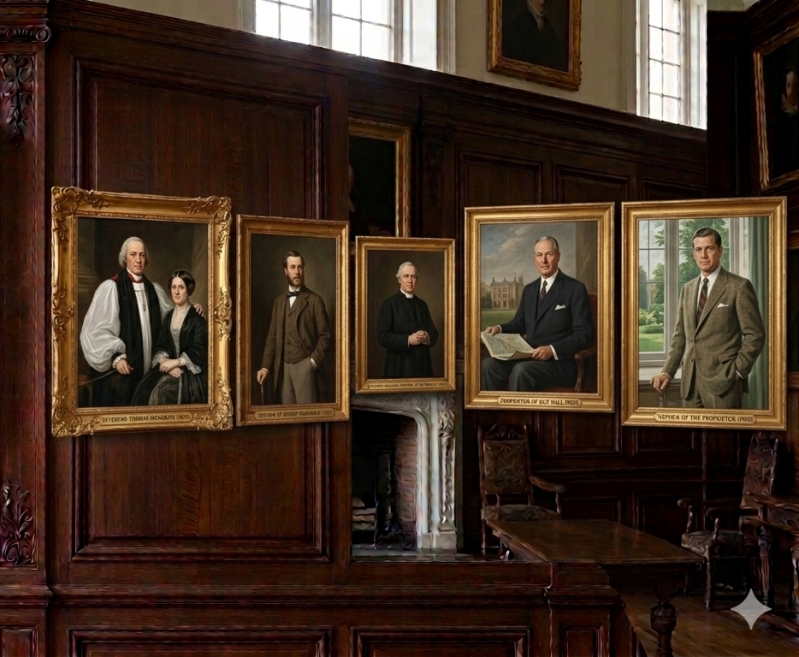
Musgrave/Francis
From the Archbishop of York to the Norman Heritage (1828 – Present)
In the 19th century, Sames reached a pinnacle of prestige under Thomas Musgrave, Archbishop of York, before joining the estates of the Francis family at Quy Hall. During this era, a major legal transformation occurred: with the reforms of 1922/1925, Sames became a "Manor in Gross." The title was decoupled from physical land ownership, becoming an independent legal and honorary entity. Following a period of quiet continuity, the lordship underwent a true homecoming in 2024. Acquired by Emmanuel Vespier, it crossed the Channel to return to Normandy. This "doctrinal repatriation" completes a thousand-year cycle, bringing the title back to the Norman legal roots that governed its very creation in the 12th century.
Medieval illustrations and historical reconstructions generated by Google's artificial intelligence.
Create Your Own Website With Webador